14,800 monthly searcheswiremap · length · POE

Best Ethernet Cable Testers (2026): Every Budget, Honestly Sorted

A cable tester answers one question - is this cable good, and if not, where does it break? The market splits cleanly into three tiers; buying above yours wastes money as surely as buying below it frustrates. All picks are real, current models, checked October 31, 2026 - links go to Amazon search for today's price.

Public specs, no fake lab testsAmazon search links, no affiliate
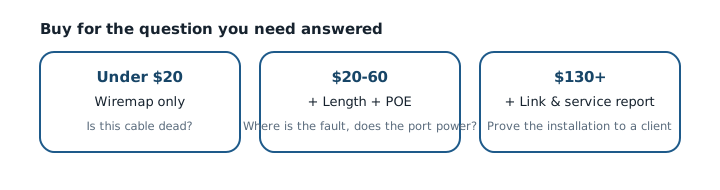
Three tester tiers by price and capability
Match the tier to the question you actually need answered.

The picks, tier by tier

#1

Eclipse Enterprise 902074 RJ45/RJ11 Tester ~$8-10

Verdict: The cheapest way to prove a cable is dead - and nothing more.

  • Wiremap only: 8 LEDs light in order
  • RJ45 + RJ11 ports
  • Slow and off/speed switch
  • No length, no POE, no shield test

Fits: A drawer backup for the occasional patch cable check.

Check 902074 price on AmazonAmazon search link - we earn nothing from it (no affiliate account on this category yet); specs above are from public product pages.

#2

Klein Tools VDV526-100 LAN Scout Jr. ~$15-20

Verdict: The default home-network tester: fast pass/fail with fault location.

  • Wiremap with fault IDs: open, short, crossed, split
  • RJ45 + RJ11
  • Auto or manual scan
  • No length measurement, no POE

Fits: Homeowners and small-office patch panels - the gift that ends "is it the cable?" arguments.

Check VDV526-100 price on AmazonAmazon search link - we earn nothing from it (no affiliate account on this category yet); specs above are from public product pages.

#3

Klein Tools VDV526-052 LAN Explorer Jr. + Coax ~$25-30

Verdict: LAN Scout Jr. plus coax ports - the right pick when TV cable shares the drawer.

  • Everything the VDV526-100 does
  • Adds F-connector coax mapping
  • Shield test for STP runs
  • Still no length or POE

Fits: Homes mixing ethernet with coax (cable TV / MoCA adapters).

Check VDV526-052 price on AmazonAmazon search link - we earn nothing from it (no affiliate account on this category yet); specs above are from public product pages.

#4

NOYAFA NF-8209 ~$45-55

Verdict: The feature cliff: length measurement, POE detection and NCV in one handheld.

  • Wiremap + fault location (open/short/cross/split)
  • Length measurement up to ~300 m (calibrated)
  • POE detection: which pairs carry power, standard or passive
  • NCV livesafe + port flash
  • Screen readout instead of LED-only

Fits: Anyone running or repairing cable professionally part-time - the best value in the list.

Check NF-8209 price on AmazonAmazon search link - we earn nothing from it (no affiliate account on this category yet); specs above are from public product pages.

#5

Fluke Networks LinkSprinter (100/300) ~$130-200

Verdict: The industry reference: plug in, get a full link report, believe it.

  • Wiremap + length + POE/PSE report
  • True link test: speed, switch port ID (CDP/LLDP)
  • Gateway/DHCP/DNS service checks
  • 300 adds WiFi reporting to the cloud
  • Battery: 2×AA, hundreds of tests

Fits: IT teams and structured cabling installers who document results for clients.

Check LinkSprinter price on AmazonAmazon search link - we earn nothing from it (no affiliate account on this category yet); specs above are from public product pages.

How the three tiers differ in one table

CapabilityUnder $20$20-60$130+
Wiremap (opens, shorts, crossed)✓✓✓
Split-pair detection✗✓✓
Cable length✗✓ (up to ~300 m)✓
POE detection✗✓ (NF-8209)✓ + switch port ID
Link/service report (speed, DHCP, gateway)✗✗✓

The pattern is simple: cheap testers prove connectivity, mid-tier testers prove workmanship, and professional testers prove the whole path. Most home users are genuinely served by the $15-20 tier; anyone who crimps their own cables should jump straight to the prosumer tier for split-pair and length alone. The full reasoning behind each row lives in the buying guide, and the wiring-order reference every tester compares against is in the RJ45 guide.

Why trust this page (and what we deliberately do not do)

We do not own a cabling lab and will not pretend otherwise. The method here is unglamorous: collect the public specifications of every current model, sort them by the questions buyers actually ask (does it find split pairs, does it measure length, does it see POE), and price-tier the result. Where a claim needs a caveat - length accuracy depends on the tester's nominal-velocity calibration, for example - the caveat sits in the text, not in a footnote. When a pick stops being current, the page updates with a dated note instead of a silent swap.

Frequently asked questions

What does a cable tester actually test?

A basic tester checks the wiremap: that all eight conductors run pin-to-pin in order with no opens, shorts, crossed or split pairs. Better testers add cable length (time-domain reflectometry), POE detection (which pairs carry power), and at the top end a true link test that reports the negotiated speed and the switch port the cable plugs into.

Can a cable tester measure internet speed?

No - and any tester claiming to is mislabeled. Testers certify the cable plant: wiring, length, and (on pro models) the maximum category the run supports. Speed is negotiated by your devices; the tester only proves the cable can carry it.

Do I need a POE tester?

If you install or troubleshoot cameras, access points or VoIP phones: yes. POE detection tells you whether a port delivers power, on which pairs, at what standard - the difference between a dead camera and a misconfigured switch is five seconds of POE test.

Why do cheap testers miss split pairs?

An LED-chain tester lights one LED per conductor in sequence; a split pair still lights every LED in order. Split-pair detection needs the smarter electronics found from the Klein VDV526 line upward - and it matters, because split pairs are the most common wiring fault in field-terminated cable.

Are the prices on this site live?

No. Prices move constantly, so every product links to an Amazon search for the current price and rating. We intentionally do not print prices we cannot refresh - a stale price is worse than none.